
Your team, multiplied.
Zovos AI is the agentic governance, risk, and compliance operating system built for fast-paced GRC teams looking to truly adopt AI-native workflows. Our agents help you manage policy and standard updates, run AI native control testing, track regulatory change, draft exam-ready responses cited to the rule paragraph, and so much more.
All of it stays under your review and approval.
Swipe through the platform
An illustrative assistant session in Zovos, in three chapters. A FinCEN rule change is mapped to three gaps cited to the rule paragraph, each waiting for review. The assistant runs a privileged access control test and files the result for a different reviewer to accept. An exam request list is matched to evidence, showing 82 percent readiness and seven tasks drafted for their owners. The session ends on links to join the waitlist and to get the Regulatory Radar.
The sidebar arranges itself by job family. Permissions still decide what each person can see.
AI that you can put in the record.
Most governance, risk, and compliance teams already use AI. They use it in a chat window beside the real work, where a control matrix or a policy has to be pasted in and the answer has to be carried back out. That makes it painful, expensive and hard to trust.
Painful
Every conversation starts by uploading the control matrix and the policies again, and every answer has to be copied back into the record by hand.
The agent works inside the record. Your controls, policies and vendors import once as real records, and each proposal is saved on the record it is about.
Expensive
Large uploads fill large context windows, and every token is metered again on each follow-up question, before anyone has checked the answer.
The agent reads only what the task needs. It retrieves the numbered paragraphs that match and drops weak matches instead of rereading the whole file.
Inaccurate
Long uploads lose the middle, and nothing in the answer shows which rows or pages were never read.
Every answer cites the versioned rule paragraph. Each run logs every input it was shown, and nothing changes until a person approves it.
Bring the assistant you already use.
Claude, ChatGPT, Copilot or any other MCP client works inside Zovos under your own Zovos role. In a client that renders MCP Apps, Zovos screens open in the conversation: ask what is on your plate, decide an approval yourself in your inbox, or bring in a register with the import wizard. The assistant never approves or signs anything, and every write checks first and saves only when you confirm.
A demo opens on the assistant's greeting and three suggested prompts. Each plays a conversation where Zovos screens open in the chat, with buttons to pause it and to go back a step. It waits for you to send each later prompt and to press each confirm yourself, and it ends with links to join the waitlist, get the Regulatory Radar, try another prompt or replay.
- Assistant
Hello. Zovos is connected under your own Zovos role. I can show what needs your decision, set up Zovos and bring in your registers, or prepare an answer for an examiner from your own evidence. You make every decision, and nothing is saved until you confirm it.
Illustrative sessions with a fictional institution, Northwind Community Bank, and demo values. The screens, labels and outcome lines follow the Zovos apps as built.
Retire the contracts. Keep the hours.
Consolidating onto one platform retires the separate tools you pay for today and gives your analysts back the hours routine evidence, vendor and mapping work takes. Move two sliders for a rough estimate.
- Contracts retired
- $190k/yr
- Analyst hours recovered
- 8,050 hrs · $426k
This is an estimate, not a quote. It uses the Tier 2 ($3B – $8B in assets) defaults of 25 hours reclaimed per analyst per week over 46 weeks at a $110k loaded salary, plus 2 hires avoided, less the $175k license midpoint.
Open the full calculatorRecently shipped.
These are the latest changes to the platform, straight from our release notes.
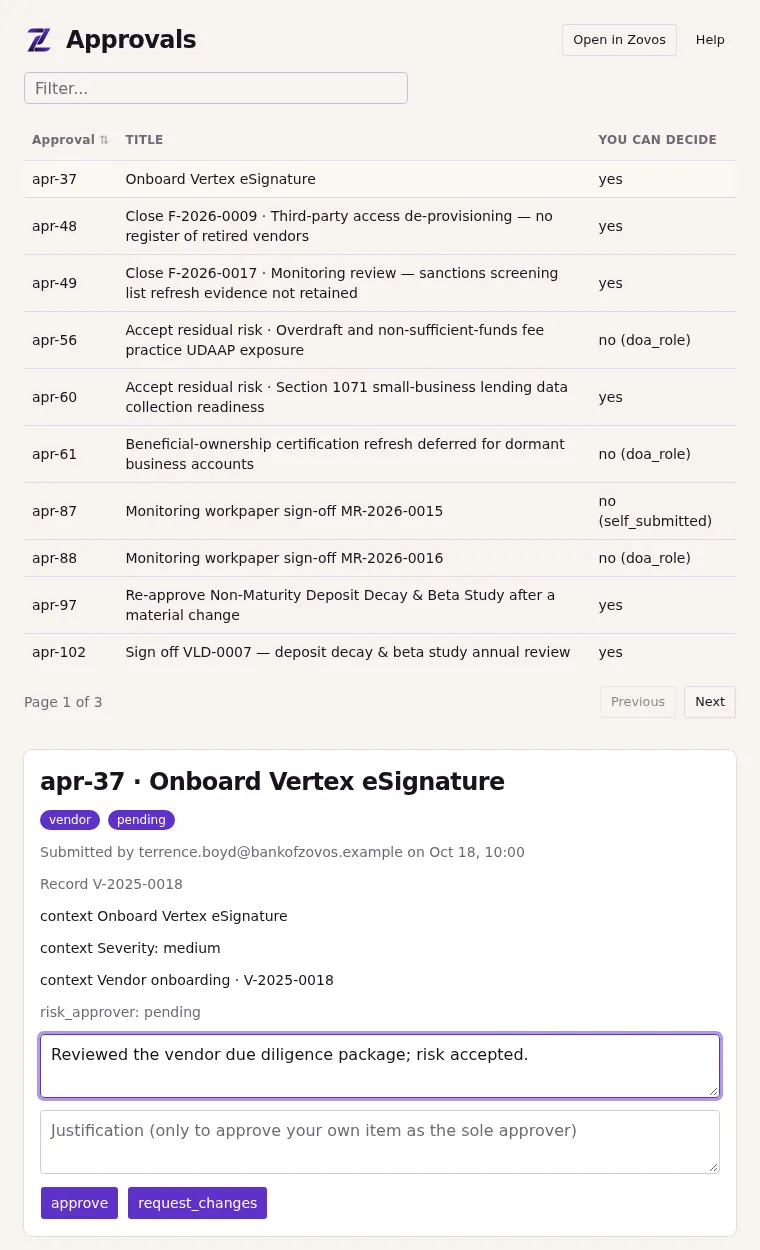
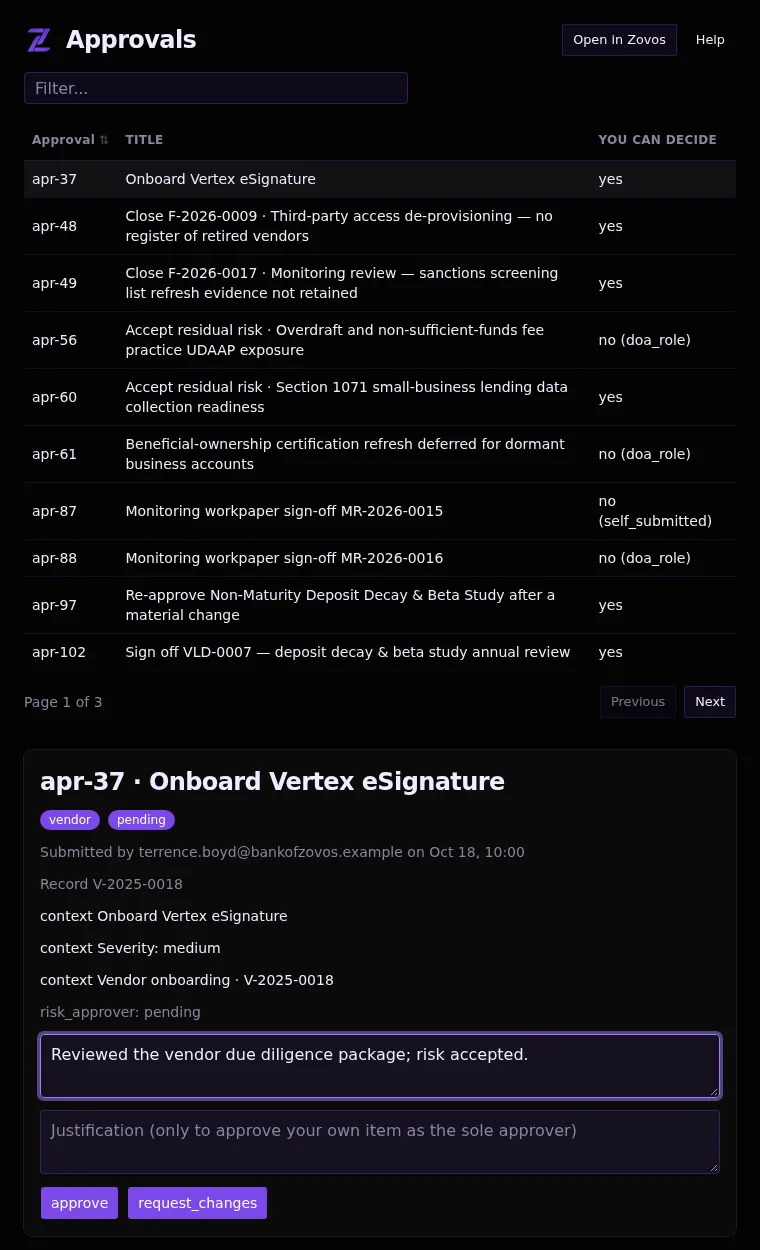
Do the day's work without leaving the conversation.
Where your AI assistant can display them, Zovos views now show your approvals inbox, findings with their remediation plans, key risk indicators with their trend, the risk register as a heat map, vendors, controls, exam request lists with their readiness and regulatory updates. From those views you can decide an approval with the same checks the web app applies, acknowledge a finding, attest to a policy or a certification, record an indicator reading, create a task, comment on a record and submit a control test result with its evidence. Every view carries the Zovos look in light or dark to match your assistant, and each result is handed back to the conversation.
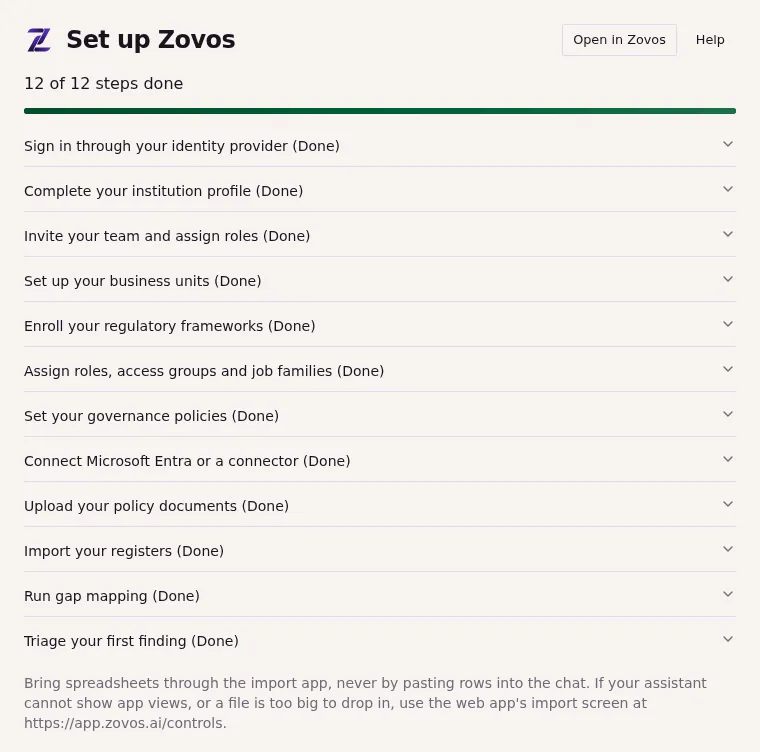
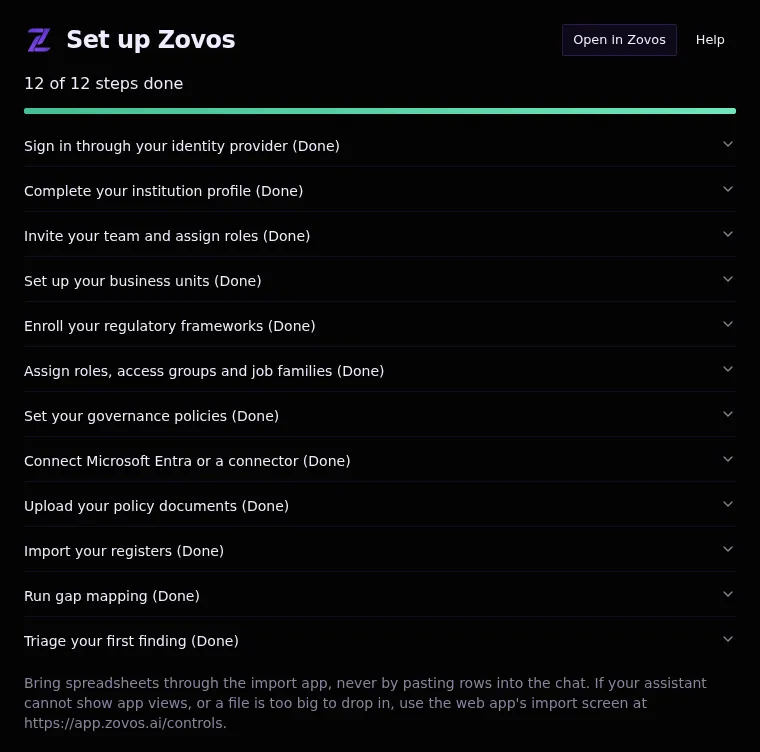
Set up your institution from a checklist or from chat.
The dashboard's getting started card now walks a new institution from sign-in to its first triaged finding, reads each step's progress from your own records, and says why a step is blocked and who can unblock it. Your AI assistant can show the same checklist and the views that do each step: invite your team and assign roles, edit custom roles, enroll frameworks, build your business units, set governance policies, connect Microsoft, upload policy documents, run gap mapping and import your registers from a spreadsheet. Files you upload in these views go straight to Zovos rather than into the conversation, and every change is previewed before you confirm it.
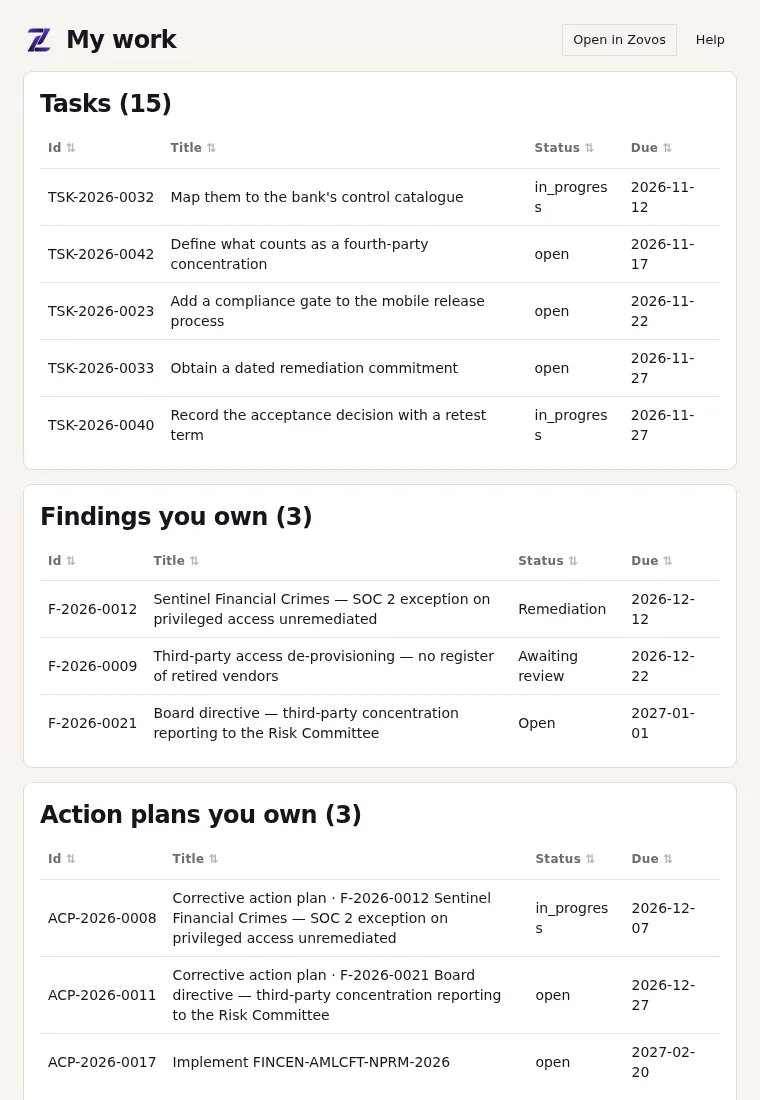
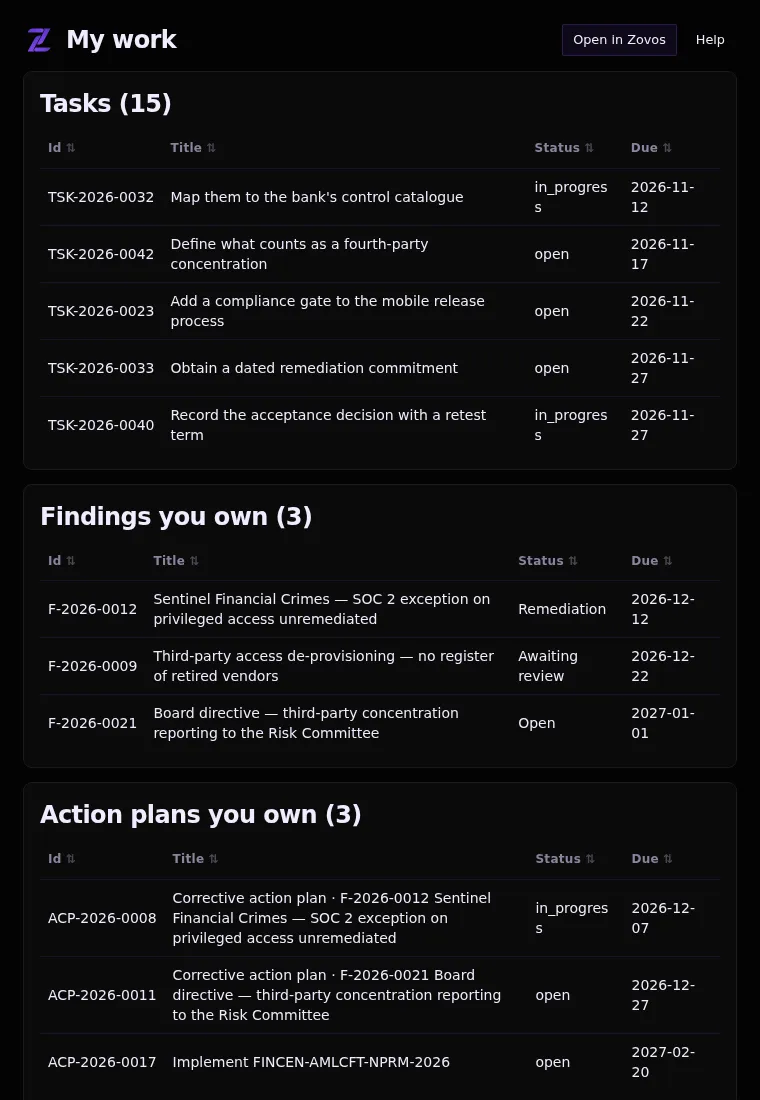
Everyone gets their own to-do list.
My work now sits at the top of the dashboard for every member and shows their own findings, action plans, audit requests and management responses waiting on them, the approvals they can decide, access reviews to perform and systems to validate. Findings, tasks and the calendar can be filtered to your own items. Business-line staff can report a loss, request an exception, raise an issue, send marketing for review, ask compliance a question or request a new AI system, and follow what happened to each submission. A finding owner can propose the corrective action plan and request an extension for the second line to decide, and a policy recipient can open the version they are asked to attest to.
Posture you can put in the exam binder.
- 13:54:11Regulatory monitorNew publication: BSA-1042-A revision (effective Jul 1)
- 13:58:03Gap analysisGap detected: §11.2 references retired access vendor
- 14:01:54Citation indexerIndexed 17 citations in §3.2.1: §5.1, §5.4, §11.2
- 14:02:19Policy mappingMapping FFIEC-2026-17 against Authentication Policy v4.2
Straight answers.
Is the preview above the live product?
The demo is pretty close as it is modeled from the real product screens. The navigation, vocabulary and screens mirror the real product. The data does not belong to anyone, it is a read-only replica of the app with a fictional institution and illustrative numbers.
Which frameworks are covered?
Zovos covers 57 frameworks today. They include FFIEC, BSA/AML, the consumer regulations (Reg B, E, Z, CC, DD, HMDA, RESPA, UDAAP, CRA), NYDFS Parts 500 and 504, NIST CSF 2.0 and AI RMF, ISO 27001 and 42001, SOC 2, PCI DSS, COSO, the IIA standards, the 2026 model-risk guidance, and the state privacy and AI laws. NIST SP 800-53, the CIS Controls and MITRE ATT&CK Enterprise Mitigations back the control baselines and crosswalks rather than being offered for enrollment. The frameworks page lists every one.
What do the AI agents actually do, and what can they not do?
There are 15 agent task types: regulatory monitoring, paragraph diffing, policy mapping, gap analysis, drafting, citation indexing, exam prep and vendor-report review among them. None of them can approve, close or publish anything. Low-confidence work is routed to a person, and every action is logged.
How long does onboarding take?
We target about two weeks for a successful onboarding cycle. We import your existing controls, governing documents, audit history, map them to the frameworks in scope, and go live before your next exam window.
How do I get access?
Join the waitlist above. We will begin onboarding after putting a couple of bows on the top and email you when your slot opens. There is no sales sequence that is triggered from the waitlist and you will hear from a real person when Zovos is ready.
What does it cost?
Pricing is flat and tier-based by institution size, with SSO, standard integrations, AI agents and regulatory content updates included at every tier. The pricing page has the tiers and an ROI worksheet.
The Regulatory Radar tracks 57 frameworks and 2,339 citations, with 13 stories in the November 1, 2026 edition. Browse the Radar
Have a question first? Talk to us.

 Bank-grade secure infrastructure

 AI with Zero Data Retention via AWS Bedrock

 Security checks on every code change
 DNS · Security · Edge